Both were buried by Vesuvius in 79 AD. They were buried differently, and that changes everything about visiting them.
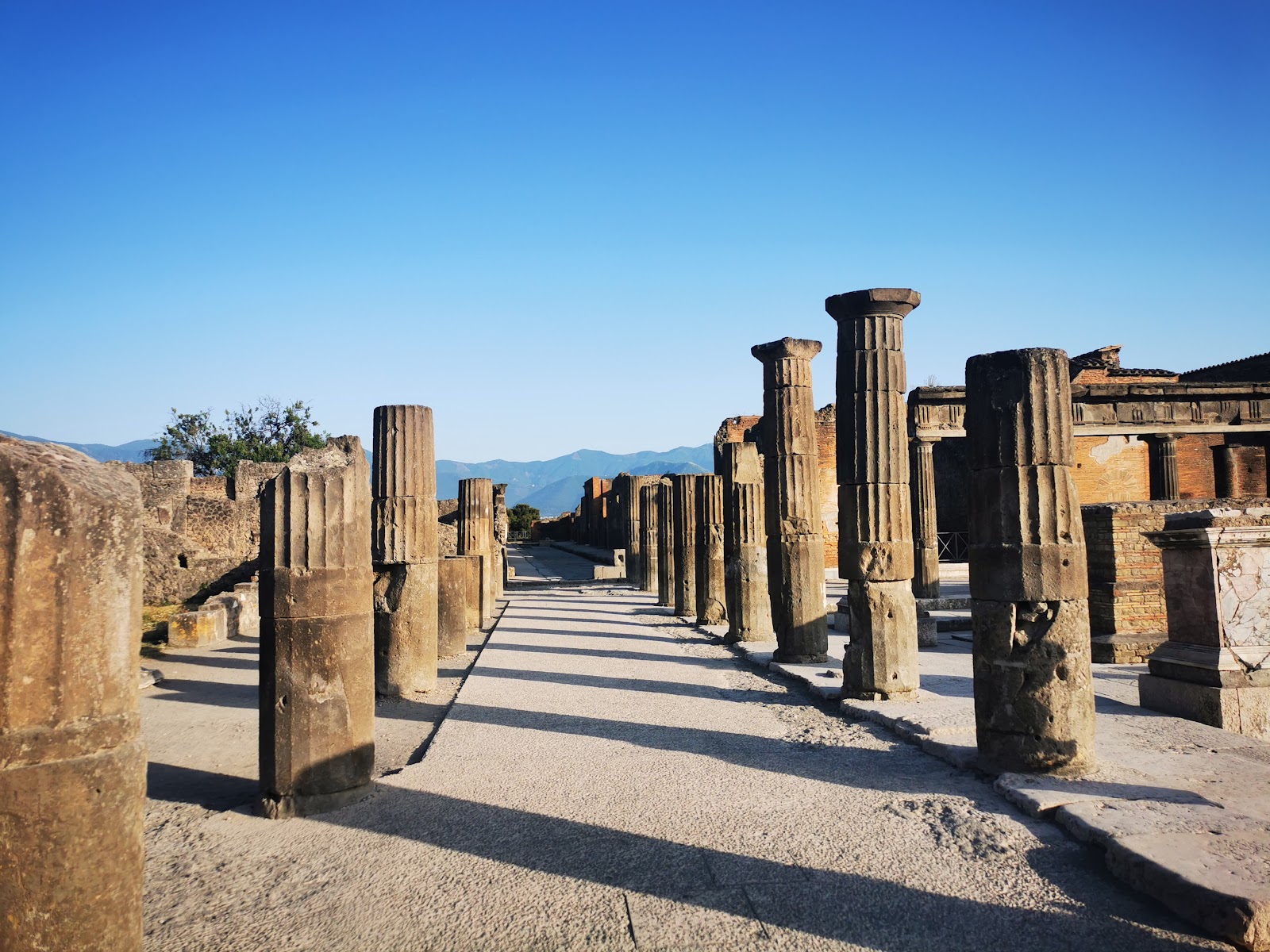
People assume these are interchangeable. They aren't, and picking the wrong one for the kind of day you want is how visitors end up sunburnt, footsore and underwhelmed.
In 79 AD Vesuvius erupted. Pompeii was buried under metres of lapilli — small volcanic stones — which collapsed roofs and preserved the layout of a whole city.
Herculaneum was hit instead by pyroclastic flows that sealed it under a dense material which hardened around everything. That's why Herculaneum still has wooden doors, beams, furniture and food, all carbonised but intact. Pompeii doesn't.
Choose Pompeii if you want scale: a whole Roman city, forum, amphitheatre, brothel, bakeries, villas, streets you can walk for hours. It is enormous, largely without shade, and genuinely tiring.
Choose Herculaneum if you want detail and preservation. It's a fraction of the size, walkable in two hours, far less crowded, and in some ways more moving — you are looking at furniture.
With children or in high summer, Herculaneum is usually the better call.
Both are on the Circumvesuviana railway from Naples: Porta Nolana or Garibaldi.
Pompeii: the stop is Pompei Scavi – Villa dei Misteri. Herculaneum: Ercolano Scavi, then about a ten-minute walk downhill.
The train is frequent but often crowded and not always punctual. You need a higher-band ticket, not a city one.
Water and a hat. Pompeii has very little shade and the stones hold heat.
Proper shoes. Roman paving is uneven and polished by two thousand years of feet.
Check what's open. Individual houses at Pompeii open and close for conservation work; the map at the entrance shows the current state.
Book ahead in peak season.
Technically yes, and it's usually a bad idea. You'd rush Pompeii, which is the one that needs time.
If you have two days for archaeology, a better pairing is Herculaneum in the morning and the National Archaeological Museum in Naples in the afternoon — that's where the mosaics, frescoes and bronzes from both sites actually are. The houses are on site; their contents are in the city.
The crater can be climbed, with a bus from Herculaneum or Pompeii to the car park and then a walk of roughly half an hour on loose gravel. It's a separate half-day, and it needs shoes.
This guide is written and maintained in Naples. The Italian version of the site has far more: hundreds of places, neighbourhood guides and long-form stories about the city. Read it in Italian.