There is a second Naples forty metres down, and it is exactly as old as the first one.
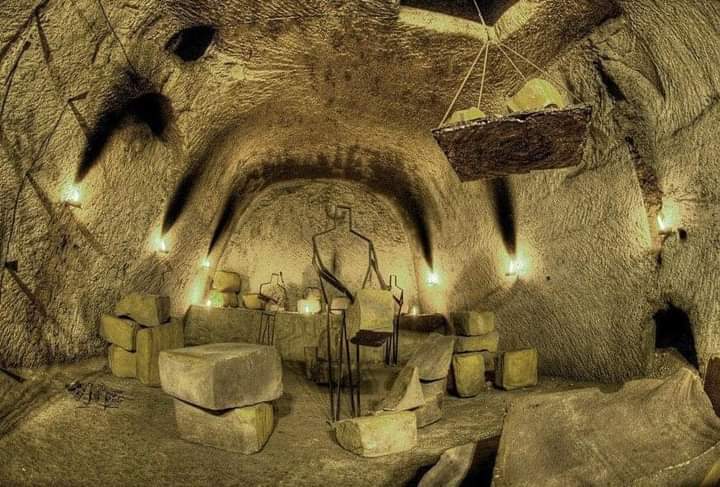
The Greeks cut tufa out of the hill to build the city above. The emptied quarries became cisterns; the Romans linked them into an aqueduct that served Naples for two thousand years. Then came the bombs, and thousands of people lived down there for days at a time.
There are several routes. They are not interchangeable, and doing two in one afternoon is one too many.
Entrance on Via dei Tribunali, in the historic centre. The classic route: 136 steps down, Greek cisterns, Roman tunnels, and the shelters used during the Second World War — Naples was the most heavily bombed city in Italy.
On the walls you can still see writing, drawings, toys and improvised beds. That's the part that stays with people.
There's an optional passage roughly fifty centimetres wide, walked holding a candle. Skippable if you'd rather not.
The visit also includes the remains of the Greco-Roman theatre, reached through the ground floor of a private home. Suetonius records that the emperor Nero performed there.
Under a medieval church, an entire Roman market street with shops, a bakery and a laundry, at the level of the ancient forum. Less dramatic than the tunnels, more legible as archaeology.
Entrance in Chiaia. Begun in 1853 as an escape route for Ferdinand II of Bourbon, who wanted a way out of the Royal Palace after the revolts of 1848. Never finished.
It became an air-raid shelter, then a municipal impound. The cars and motorcycles down there are from the 1940s and 1950s, left where someone parked them and never reclaimed. It is the most cinematic place in Naples and almost nobody knows it exists.
Different routes are offered, including one crossing water on a raft on certain days.
San Gennaro, under the Capodimonte hill: two levels of wide galleries with frescoes from the second century, including the oldest known image of the city's patron saint. Since 2006 they have been run by a cooperative of young people from the Sanità district — one of Italy's most successful cases of heritage generating local work.
San Gaudioso, under the Sanità basilica, includes seventeenth-century scolatura burials: niches where bodies were dried upright, the skull walled in and the rest of the body painted on the wall.
Free, and not a guided route. A tufa quarry the size of a nave holding the bones of tens of thousands of plague and famine dead, where Neapolitans practised the cult of the anime pezzentelle — adopting an anonymous skull in exchange for protection. Banned by the archbishop in 1969.
Temperature underground is a constant 15-16°C all year. In August that's a relief; bring a layer anyway.
Closed shoes. Many steps, no lifts: none of these routes is accessible to people with limited mobility.
Book. Most are guided, in groups, and fill up at weekends.
This guide is written and maintained in Naples. The Italian version of the site has far more: hundreds of places, neighbourhood guides and long-form stories about the city. Read it in Italian.